- Proof of Words
- Posts
- Bitcoin ETFs Post Their Biggest Inflow Day Since January, While the ECB Puts Central Bank Money On-Chain
Bitcoin ETFs Post Their Biggest Inflow Day Since January, While the ECB Puts Central Bank Money On-Chain
The ETF bid is back, and Europe puts a date on on-chain settlement.

Patrick Lowry
September 10, 2026
While the Bitcoin price spent the week digesting its best August since 2017, spot Bitcoin ETFs posted their strongest three-week run of 2026, the ECB confirmed its tokenized settlement pilot goes live on September 21, and 21 of the world's largest financial institutions committed to launching a stablecoin together.
TL;DR
U.S. spot Bitcoin ETFs pulled in $731 million in a single day, the biggest inflow since January 14, inside the strongest three-week stretch of 2026.
The ECB's Pontes pilot goes live on September 21, settling tokenized trades directly in central bank money.
Twenty-one financial institutions, including Citi, Goldman Sachs, Bank of America, and UBS, committed to launching a joint dollar stablecoin.
The Biggest ETF Inflow Day Since January 📈
Let's start with the flows, because they tell you more about market posture than any headline.
On September 3, U.S. spot Bitcoin ETFs took in $731 million in net inflows, the strongest single day since January 14. BlackRock's IBIT absorbed roughly $454 million of that on its own, with ARK's ARKB adding about $138 million and Fidelity's FBTC another $74 million.
That day sits inside a three-week stretch of net inflows totaling $3.8 billion, the strongest run of 2026 (full daily data here). The ETF complex now holds roughly 1.27 million BTC, worth around $100 billion.
Now for some honesty, because I know some of you will check my math: even after this run, the spot ETFs are still about $1 billion net negative for 2026. The first half of this year was challenging, and three good weeks don't erase six hard months.
But here's my read. Bitcoin fell from its October 2025 high all the way to the low $60,000s by mid-August, which is roughly a 50% drawdown. Then, August closed up 24%, the best August since 2017, and the price pushed above $82,000 on September 3, its highest level since May, before Friday's jobs report knocked it back toward $78,650.
Through all of that, the money kept flowing in. ETF flows don't come with name tags, and these vehicles serve everyone from family offices to individual investors. But having sat on the other side of the table in traditional finance, I can tell you that sustained billion-dollar weeks after a 50% drawdown look a lot more like large capital allocators building positions than tourists chasing a chart.
The ECB Puts Central Bank Money On-Chain 🇪🇺
The second story got a fraction of the attention it deserves.
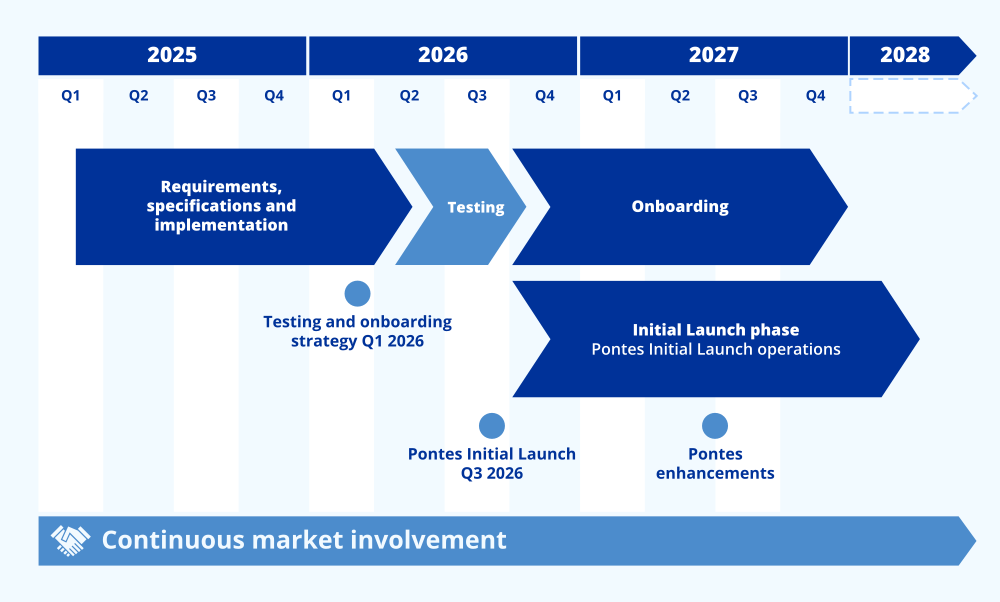
On September 21, the ECB's Pontes pilot goes live. Pontes connects private tokenization platforms to TARGET Services, the Eurosystem's settlement infrastructure. In practice, it links delivery and payment in a single atomic step: the buyer receives the tokenized security, and the seller receives central bank money, which sharply reduces settlement risk.
Settlement is the part of capital markets hardly anyone tweets about, and the part where everything can go wrong. Institutions have run tokenized trades for years, including the Eurosystem's own 2024 exploratory trials, but access to central bank money for settling them has stayed limited.
Pontes is the ECB turning those experiments into a standing service, and that takes one of the biggest institutional objections off the table.
The pilot starts small, with limited operating hours. The ECB is targeting a round-the-clock Pontes service by mid-2028, while its longer-term Appia track is due to deliver a blueprint for integrated DLT-based capital markets in 2028. There's still work ahead on interoperability and standards, but combine this with MiCA and the DLT Pilot Regime, and Europe is assembling a regulated path from issuance to trading to settlement.
Wall Street Wants Its Own Stablecoin 🏦
Last week I wrote about Main Street's bankers planning their own blockchain. This week, the giants moved.
On September 1, a group of 21 financial institutions, including Bank of America, Citi, Goldman Sachs, UBS, Fidelity, and WisdomTree, went from exploring a joint stablecoin (which they'd been studying since October 2025) to committing to establish a stablecoin company in the second half of 2026, with a dollar token targeted for the first half of 2027.
The plan covers wholesale, institutional, and retail payments plus digital asset settlement, and the group says a euro-denominated coin is the next priority.
While plenty hasn’t been disclosed yet, like which blockchain they will choose, which custodians they’ll use, and what their governance structure will look like, they did disclose their intent to comply with the GENIUS Act and MiCA, as applicable.
A year ago, this was an exploration project. Now, 21 competitors who agree on almost nothing have agreed to build one token together, because they've concluded the market is leaving without them.
And for my European readers: the euro coin ambition matters. If the second-largest currency bloc gets a bank-issued, MiCA-compliant stablecoin while the ECB settles tokenized trades in central bank money, Europe's digital asset infrastructure starts to look a lot better.
One for the Calendar 🗓️
Next Tuesday, September 15, at 2:15 p.m. ET, the Senate votes on cloture for the CLARITY Act's motion to proceed. It needs 60 votes. The House passed the bill 294 to 134 last year, and Senate Banking cleared it 15 to 9 in May, but the floor is where market structure bills go to be tested.
In my view, the biggest reason institutions sat on the sidelines for so long was never volatility. It was legal uncertainty. Tuesday won't settle that on its own, but it will test whether the bill can advance toward floor consideration, and that tells us plenty about Washington's appetite. I'll break down the result next week.
Elsewhere in Bitcoin 📖
A quick look at what else has been happening in Bitcoin:
Capital B buys 376 BTC for €25.3 million, its largest single purchase in a year, taking the French treasury company to 3,521 BTC with backing from Adam Back
The Smarter Web Company adds 35 BTC, bringing the UK-listed firm's treasury to 2,747 BTC
Wells Fargo plans to launch tokenized deposits this fall, initially supporting limited USD-to-GBP transactions, per its August announcement
Your fellow stacker in sats,
Patrick Lowry
PS: If you want to see how the value of goods and services changes when priced in Bitcoin, check out the Samara Bitcoin CPI. It might give you a new perspective on holding Bitcoin on your company's balance sheet or just as an individual.

Disclaimer: The opinions expressed in this newsletter are solely those of the author and do not necessarily represent the views of any associated company. This newsletter is for educational and informational purposes only and should not be construed as investment, financial, or any other professional advice. Nothing here is a solicitation, offer, or recommendation to buy or sell any asset or to use any service. Investing in cryptocurrencies is highly speculative and carries a significant risk of substantial financial loss, so you must conduct your own thorough research and consult with independent professional advisors before making any decisions.